Start with a task, a name and a backup.
To plan practical postpartum support, write down the help you expect to need, who has agreed to do each job, when they’re available, and who can step in if plans change. Start with meals, home tasks, a person to talk to, and your care-team contacts. You don’t need to arrange every possible service.
Najoud’s guide starts from her experience of preparing for her baby while overlooking her own support needs, with family living abroad. Its organising idea is a village for the mother, baby, partner and home—not just supplies for the baby.
This checklist focuses on arranging people and practical help. It is not a medical care plan or a substitute for medical advice. Your clinician should guide decisions about recovery and your baby’s care.
1. Name your people before choosing services.
Write down the people you already trust: your partner, relatives, friends and any help at home. Then identify the gaps. A relative who lives abroad might help with calls or admin, even if they can’t bring dinner. A nearby friend may be able to do an errand without committing to a whole afternoon.
- For you: someone you can speak honestly with, and the medical or feeding-support contacts you choose with your care team.
- For baby: your pediatrician’s contact details and their after-hours arrangements.
- For your partner: their agreed time away from work, the jobs they will own, and someone they can turn to as well.
- For home: people who can help with food, cleaning, errands or older children, if you have them.
Building Your Village: Free Postpartum Support Guide separates essentials from helpful additions and optional extras. Use the same principle here: arrange the gaps that matter most to your family first, within your budget. Paid help is one option, not a requirement.
2. Give each everyday job an owner.
“We’ll all help” leaves a lot to organise. Write down who will do the whole job, including the planning and follow-through. Agree daytime and night-time responsibilities with your partner; discuss feeding or care questions with your clinician rather than treating this list as care instructions.
Here’s an example to adapt—not a fixed schedule:
| Job | Who owns it? | What to agree | Backup |
|---|---|---|---|
| Meals and groceries | Partner or willing friend | Which days, food preferences and ordering budget | A saved delivery option |
| Laundry and basic cleaning | Partner, relative or home help | Which tasks and when they’ll be done | Another willing helper or service |
| Older children, if relevant | A trusted caregiver | School runs, pickups and contact details | A second agreed caregiver |
| Visitors and Mubaraka | A person you nominate | Your preferred times and who handles messages | Postpone visits when needed |
| Paperwork and appointments | Partner or agreed helper | Who checks local requirements and keeps track | A shared list of what’s still open |
For paid help, check availability, duties, costs and cancellation terms directly. Don’t mark a job as covered until someone has actually agreed to it.
3. Replace “let me know” with a specific ask.
Make it easy for someone to say what they can genuinely offer. Include the job and a realistic time window, and leave room for them to decline.
“Would you be able to bring dinner one evening in our first week home? I’ll confirm the day after the birth. If that doesn’t work, no pressure—could you help with a grocery order instead?”
For your partner, turn a general promise into clear ownership: “Could you manage the grocery list, orders and deliveries while we settle in, without waiting for me to organise each one?”
Agree visitor preferences together, including Mubaraka if your family chooses it. Decide who communicates those preferences so you don’t have to answer every message.
4. Keep a backup and your contacts in one place.
People get sick, work plans change and babies don’t arrive to a timetable. Ask who could step in for the jobs you most depend on. Save the details somewhere both you and your partner can find.
- Your chosen medical team’s contact details and after-hours instructions
- Your pediatrician’s recommended emergency arrangements, confirmed directly with them
- A backup for practical home help
- A trusted person you can call for a conversation
- Confirmed service bookings, costs and the tasks still waiting for an owner
The original guide includes a night-time emergency contact sheet. Confirm current emergency details, hospital access and insurance arrangements locally; don’t rely on a general guide to decide when medical help is needed.
Your before-birth support checklist
- List the everyday jobs you expect to need help with.
- Name one willing owner for each priority job.
- Confirm availability, including what happens if your birth date changes.
- Agree any paid-help budget and booking terms.
- Choose a backup for the jobs you depend on most.
- Share your care-team contacts and visitor preferences with your partner.
- Keep one shared list, and revisit it after you’re home as your needs become clearer.
You can start small. One agreed meal delivery, one person handling the home tasks, and one honest conversation about roles are concrete steps—not another perfect plan to finish.
Build the rest of your village.
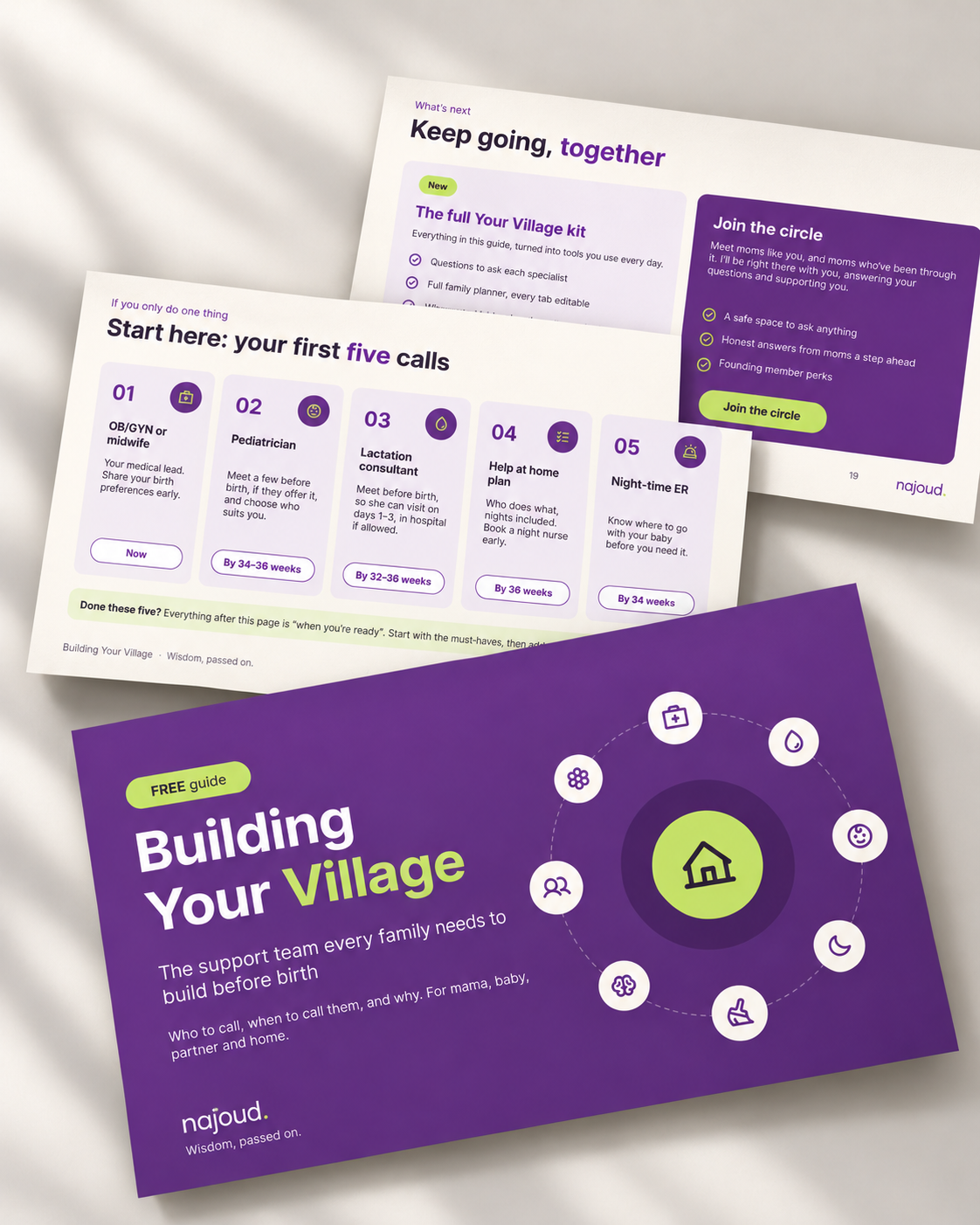
Building Your Village: Free Postpartum Support Guide brings together who to call, when and why, with planning sheets for you, your baby, your partner and home.
 Get the free guide
Source: Najoud Al-Jabri, Your Village: The support team every family needs to build before birth, particularly “How to use this guide” (p. 4), “Your partner’s team, too” (p. 11), “Help at home, planned” (p. 12), “Money and paperwork that protect you” (p. 13) and “Visitors and Mubaraka” (p. 14). The example table and messages above adapt these planning themes; they are not quotations or clinical recommendations.